
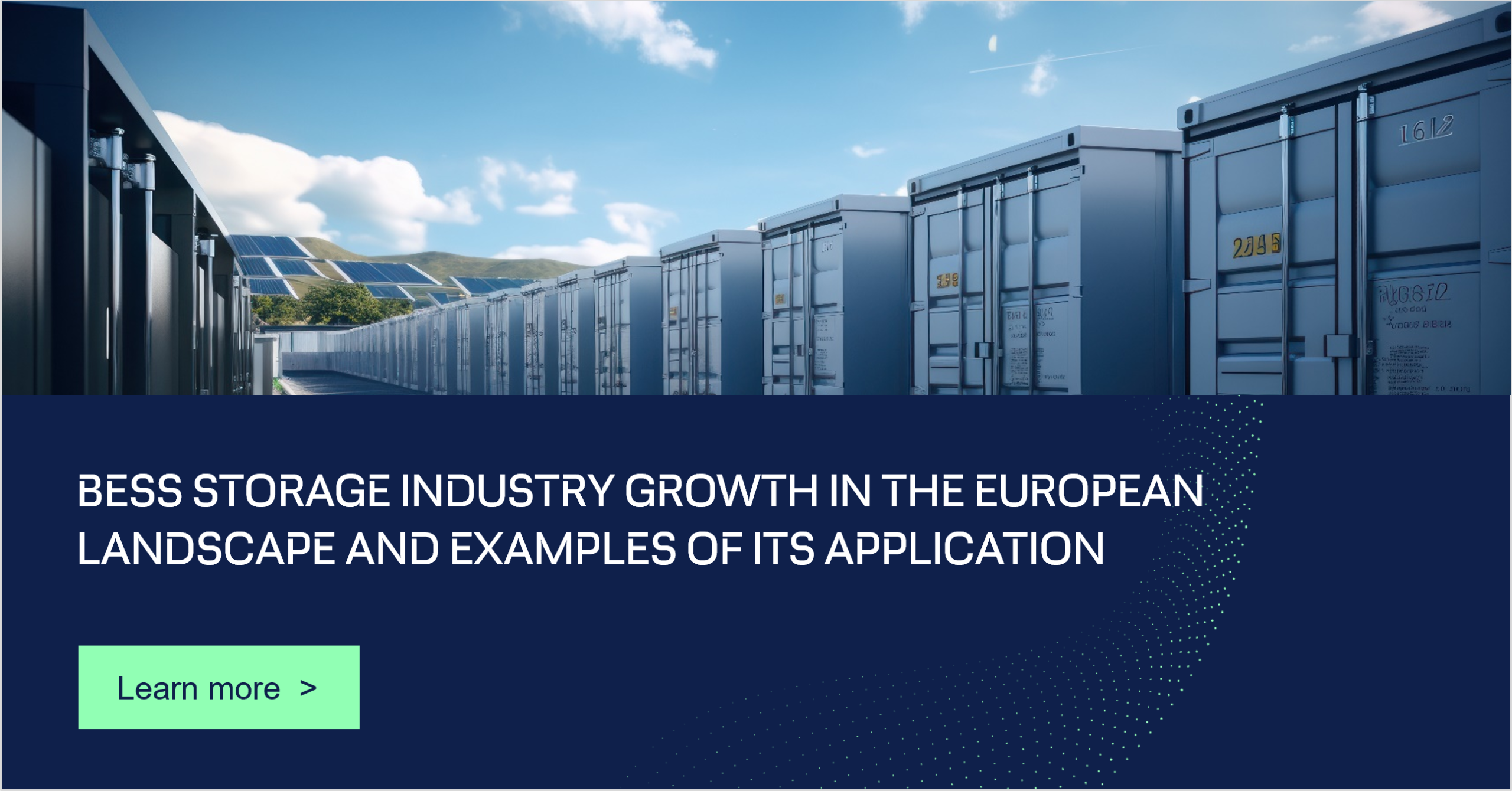
According to the DNV Energy Transition Outlook (ETO) 2025, “As power systems evolve to integrate more variable renewable energy sources, electricity storage emerges as a critical enabler of grid stability and flexibility.” The falling cost trends of Li-ion batteries also support this battery revolution. Looking at BESS Europe in particular, a recent report by SolarPower Europe tells us that 27.1 GWh of new battery capacity was installed across Europe in 2025, signifying the EU’s 12th consecutive record year for battery storage deployment. To add to that, “55% of all new capacity came from utility-scale systems, confirming large-scale storage as the main engine of EU market growth.”
Europe Battery Energy Storage System (BESS) market
The SolarPower Europe report also sets out priority areas to support scaling of BESS in Europe, including though simplifying permission for storage and hybrid projects, building affordable and resilient supply chains, and developing global partnerships to diversify supply.
As BESS deployment increases, as well as the policy factors supporting the growth, it becomes equally important to understand how these systems are used in real projects and the roles they play across the energy landscape. In this article, we explore key BESS applications, address common FAQs, and present an example use case to illustrate how storage supports both grid operations and end‑users.
Applications for BESS storage: including grid reinforcement, commercial and industrial applications
A key value of BESS is its ability to manage renewable output, storing excess solar or wind generation and delivering it as controlled, dispatchable power that meets grid‑code and system‑stability requirements.
Renewable Energy Integration
Battery Energy Storage Systems (BESS) store excess renewable generation and release it during periods of low output or high demand; BESS changes intermittent resources into predictable, dispatchable assets. Storage also supports voltage regulation, frequency control, and ramp‑rate smoothing, helping renewable plants comply with increasingly strict grid‑code requirements. As renewable penetration grows, BESS becomes essential for ensuring that clean energy can be reliably delivered to the grid at scale. Take a look at our article on long-term duration BESS system energy storage for more information here.
Grid reinforcement
Where network constraints limit new connections or load growth, BESS provides a flexible alternative to traditional grid reinforcement. By absorbing excess generation, supplying power during peak demand, and providing fast reactive support, BESS can relieve local constraints without physically expanding the network. This approach allows operators to defer or avoid costly reinforcement projects, enabling faster connections of new loads or renewable assets, and improve overall system reliability with far shorter deployment timelines.
Commercial
Battery Energy Storage Systems (BESS) are increasingly being adopted by commercial organizations (e.g. warehouses or data centres) seeking greater control over their energy costs and operational resilience. Commercial facilities often face high charges linked to their maximum demand – BESS mitigates these costs by discharging during peak consumption periods. This approach reduces exposure to volatile tariff structures. In this segment, storage functions not only as a technical asset but in supporting business continuity and long‑term competitiveness.
Industrial
Industrial sites (e.g. facilities with heavy equipment or cyclical production) frequently experience short‑duration load spikes driven by heavy machinery start‑up, thermal processes, or batch production cycles. BESS discharges during these transients, reducing the facility’s maximum demand and lowering exposure to demand‑based tariff components. This reduces maximum demand charges and smooths the facility’s load profile without disrupting operations. BESS provides instantaneous support during outages maintaining production until generators synchronize, or the grid recovers.
Project use case: Hybrid solar + storage project in the UK
GreenPowerMonitor, a DNV company (GPM) manages BESS storage and hybrid projects globally (across Europe, North and South America, Asia-Pacific, India, the Middle East and Africa). This example is one of the UK’s largest and most advanced hybrid solar farms. The plant intelligently manages energy flows and also implemented the UK’s grid‑connection standard, Engineering Recommendation G99, ensuring safe, compliant, and future‑ready operation.
Key project capacities
- Combining solar + storage
- With a capacity of over 35 MW of PV + 27MVA of storage
Role and delivered solutions
The plant works with the following control and monitoring technologies tailored to the project’s operational and grid integration needs, including:
- GPM SCADA
- GPM Power Plant Controller
GPM’s engineering and grid integration teams worked closely with project partners to develop a resilient, adaptable control architecture that ensures dependable performance and seamless operation.
To read more about working together, regulations for BESS projects and our solutions, download our latest guide ‘How to succeed in BESS projects.’
BESS FAQs
To help clarify some of the most common questions around storage and its operation, the following FAQ section provides brief explanations of key concepts.
How efficient are BESS storage systems?
BESS systems are generally highly efficient, with modern lithium‑ion installations, for example, achieving impressive round‑trip efficiencies of around 80-95%, depending on factors such as battery chemistry, inverter performance, operating temperature, and cycling strategy; this means that most of the energy stored can be returned to the grid or facility when needed.
Why are BESS storage systems important to renewable energy?
BESS systems are important to renewable energy because they transform variable solar and wind generation into a stable resource. They can store excess production when output is high, and therefore deliver this stored power during periods of low generation or peak demand, when additional power needs to be supplied. Overall, this allows the grid to maintain reliability while supporting much higher levels of renewable penetration.
What types of systems help manage BESS storage projects?
As an overview, BESS (Battery Energy Storage System) projects are similar to a stack of control systems layered on top of each other, with each taking care of a different responsibility. This includes a Battery Management System (BMS) which monitors voltage, temperature, and current. The Power Conversion System (PCS) controls the inverter that connects the battery to the grid, and performs bidirectional DC–AC conversion, controls active and reactive power, and provides grid support. The Energy Management System (EMS) decides when to charge or discharge and optimizes for site demand. The Supervisory Control and Data Acquisition (SCADA) offers real-time monitoring of the plant including data collection and an operator interface. A Hybrid Controller is needed when BESS is also combined with solar or wind.
What is important to consider when choosing platforms to manage BESS storage systems?
When choosing a system to manage a BESS, the most important factors are its ability to provide reliable real-time control, ensure grid code compliance, and optimize the asset’s performance across different operating modes. A strong platform should include SCADA functionality, and an Energy Management System that can adapt to tariffs, market signals, and site-specific load profiles. Cybersecurity, interoperability with inverters, and the ability to scale as the asset grows also ensure the system remains stable and aligned with evolving grid and market requirements.
Take a look at our recent article on what organizations need to succeed in BESS projects here.
Hybrid and BESS systems at GreenPowerMonitor, a DNV company
At GreenPowerMonitor, a DNV company (GPM), we develop and implement projects across the globe with our Energy Management Systems (EMS), and Hybrid Energy Management Systems (HEMS), working with technical requirements which can be complex. Our teams ensure seamless integration supported by a library of more than 400 communication protocols. All solutions are designed to meet key cybersecurity and quality standards, including NIS2, IEC 62443, and ISO 27001. GPM’s solutions for BESS and hybrid projects include the following:
- Enhanced Energy Management System (EMS), improving battery storage performance by optimizing energy dispatch, prolonging asset lifespan, and maintaining grid reliability in BESS storage projects.
- Hybrid Energy Management System (HEMS), ensures hybrid project reliability and efficiency, enabling seamless coordination between PV and battery energy storage systems (BESS), optimizing internal power flow for efficiency, cost-effectiveness, and grid compliance.
- Power Plant Controller (PPC), acts as a bridge between renewable energy generation and the grid. The PPC is designed for conventional renewable power plants with unidirectional power flow, such as PV and Wind, without energy storage capabilities.
Additional features include EMS Logic to help in complying with grid codes worldwide, and Battery Management System (BMS) for improving operational efficiency and flexibility.
- GPM Horizon for multi-tech portfolios (solar, wind, and storage), offers multi-technology monitoring and advanced analytics. GPM Horizon includes near real-time analytics and alerts, KPI tracking, and automated reporting.
“BESS projects succeed when technology, controls, and grid requirements work together. Our role at GPM is to make that complexity manageable for our customers, ensuring that storage or hybrid asset operates reliably from day one and continues to deliver value. We support customers with solutions that are technically robust, grid‑compliant, and adaptable.” Alejandro Robles, Grid Integration Engineer
Conclusion
Battery energy storage is becoming a key element of Europe’s modern energy system, supporting record renewable deployment, easing grid constraints, and strengthening commercial and industrial operations. With falling battery costs, strong policy momentum, and a growing need for flexibility, BESS is enabling more reliable power systems while delivering value across generation, network, and end‑user applications.
Do you want to meet us and talk to our renewable energy experts?
For more information on GPM and how we can support your BESS projects, fill in the form to request a meeting with our renewable energy experts who will be available to answer questions, provide demonstrations, and offer insights on best practices.
