

In the days leading up to the solar eclipse on August the 12th, significant attention was given to its potential impact on solar generation, electricity markets, and grid operations. Forecasting studies highlighted how the eclipse could temporarily reduce solar irradiance and create notable generation ramps across several US and European markets.
Now that the event has passed, a different question emerges:
What was the actual impact on energy production at the asset level?
To answer this question, we analyzed operational data from utility-scale PV plants in Spain, the UK and the northeastern US. By comparing its performance during the eclipse with neighboring sunny days exhibiting optimum plant performance, we were able to isolate the effect of the eclipse on energy production.
The results show that the impact was clearly measurable. Although the eclipse occurred late in the afternoon in Spain and the UK, when solar production was already naturally declining, the plants experienced an estimated reduction up to 0.8 to 1.1% in daily energy generation. The actual loss depends on the mounting and orientation, as well as the actual weather in the location of the PV plant.
In the US, the eclipse took place around midday. However, its impact was similar, resulting in an estimated loss of approximately 1% of daily energy production.
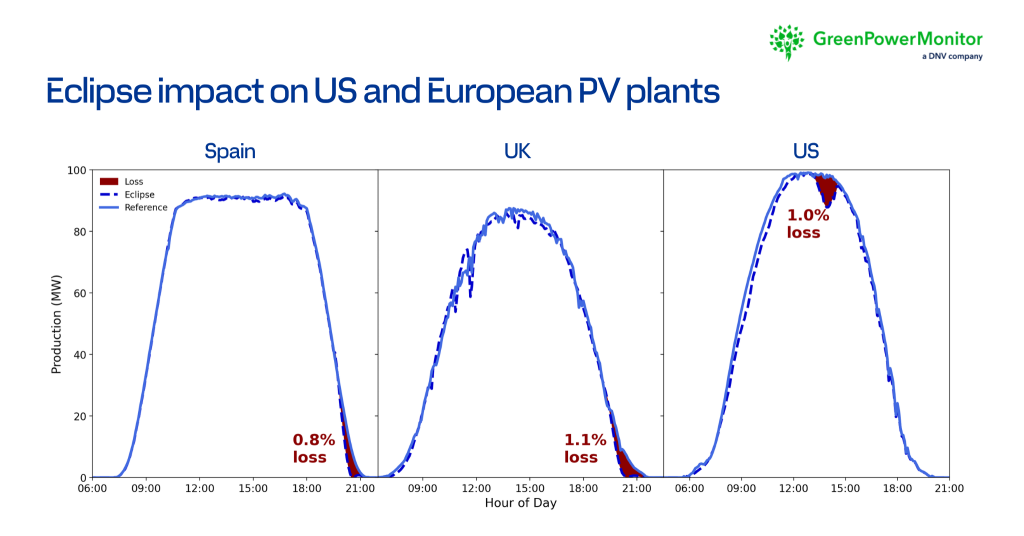
Interestingly, this observation closely aligns with pre-event forecasts, which projected daily irradiance losses of around 1% across those regions due to the timing of the eclipse.
At first glance, the result may appear higher than expected for an event that reached totality for only a brief period and only in certain regions. However, the impact was not limited to the time and locations where the total eclipse took place. The reduction in irradiance began well before totality and persisted for approximately one to two hours, creating a sustained effect on plant output production.
This highlights an important reality for solar asset operators: even short-duration astronomical events can leave a measurable footprint on energy production.
More importantly, the analysis demonstrates how forecasting and monitoring complement each other throughout the asset lifecycle.
Forecasting helps operators understand what is likely to happen and prepare accordingly. Monitoring and performance analytics enable them to assess what actually happened, quantify performance impacts, separate those impacts from normal operational variability, and translate observations into actionable insights.
As solar assets continue to increase in scale and importance within the global energy mix, understanding the effect of every event becomes increasingly valuable, whether those events are meteorological, operational, grid-related, or astronomical.
The August eclipse serves as a reminder that effective asset management is not only about predicting events. It is also about measuring their real-world consequences and understanding how they affect asset performance over time.
Do you want to meet us and talk to our renewable energy experts?
To ask more about secure, compliant, and future-ready energy monitoring and control systems, fill in the form to request a meeting with our renewable energy experts. Together, we can strengthen the resilience of your critical infrastructure and ensure full confidence in cybersecurity and data integrity.
