
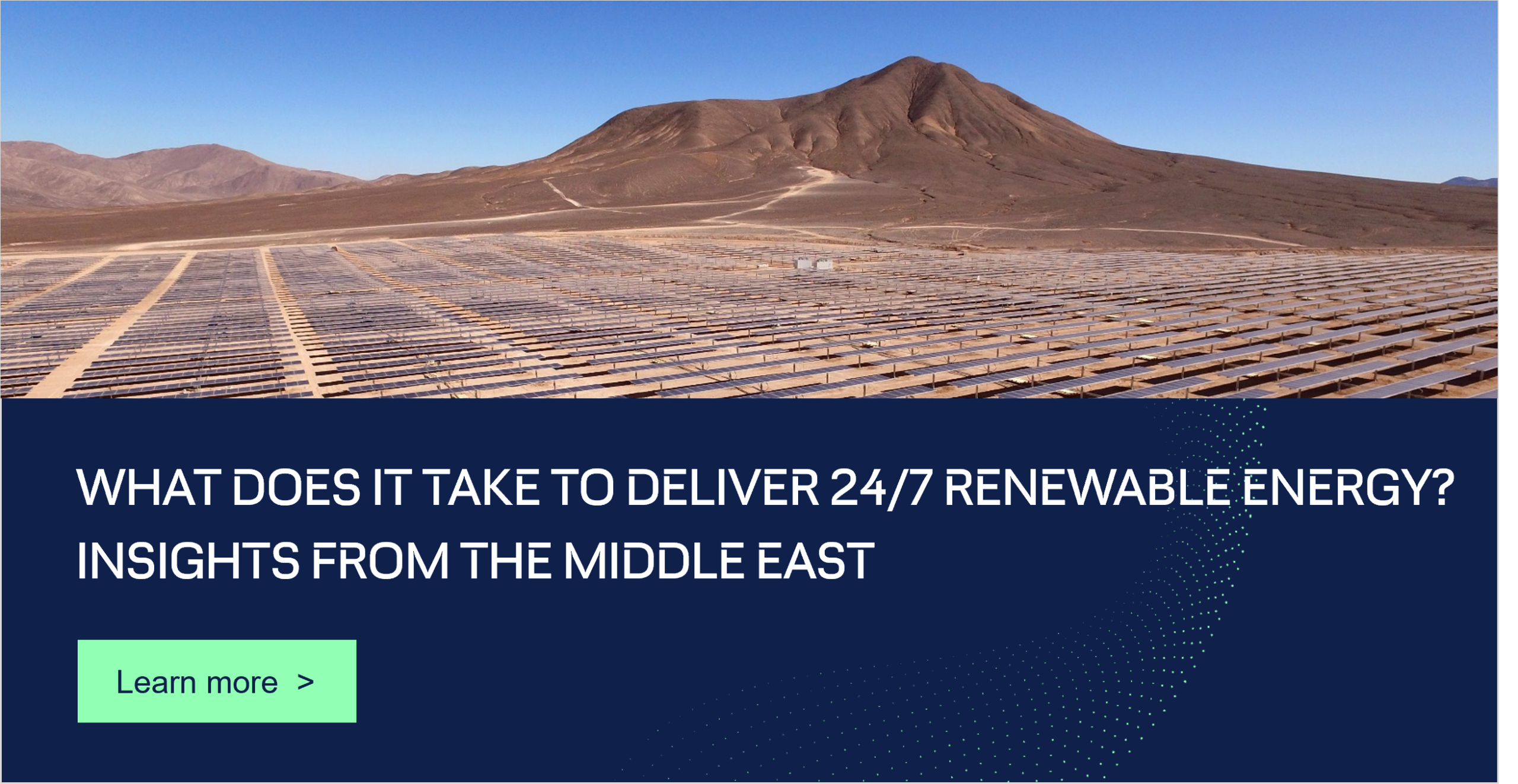
Introduction: The region’s renewable ambitions are growing
The United Arab Emirates (UAE) and the Kingdom of Saudi Arabia (KSA) continue to lead renewable energy development in the MENA (Middle East and North Africa) region, setting ambitious benchmarks for other markets to follow. Governments and private sector organizations in the region are also playing an active role in the transition.
This growth comes as demand for energy is increasing rapidly. In fact, according to the DNV Energy Industry Insights 2026 Special Report, globally, 57% report that energy demand in their region is growing faster than supply can keep up (and in the Middle East and Africa this figure is 72%).
Meeting this demand requires renewable projects to deliver at greater scale and with greater flexibility. Across MENA, increasingly large solar PV and storage projects are bringing new challenges around scalability and grid integration, while hybrid projects are combining multiple technologies to provide more reliable power. This raises an important question: how can renewables move beyond intermittent generation to deliver reliable power 24/7 and Round-the-clock (RTC) energy?
Changing what is possible in the Middle East: addressing variable weather and providing 24/7 power
The MENA region, while rich in resources, also faces extremes in weather conditions that can bring challenges in terms of effective operation of power plants.
The DNV Energy Industry Insights 2026 Special Report suggests that the Middle East and Asia Pacific report greater preparedness with regards to aspects such a having a clearly defined resilience strategy, and effective hedging strategies in place to manage price exposure and volatility. Possibly because countries in those regions are among the most affected by extreme weather events.
The key technology that addresses variable weather patterns and complements solar PV and wind is energy storage. Combining solar generation with battery storage offers a cost-effective solution that can be deployed relatively quickly, making it one of the most promising pathways to delivering reliable, continuous renewable energy.
The first projects designed to deliver RTC or 24/7 renewable energy are already being implemented in the MENA region, including on one the world’s largest solar and BESS storage projects, based in UAE.
The significance of such projects goes beyond their size. They demonstrate a change in what renewable projects are being asked to achieve: increasingly to deliver power and energy when the system needs it.
24/7 renewable energy needs: including modelling and forecasting capabilities
However, delivering renewable power RTC or 24/7 is not simply a question of adding more battery capacity to a solar project. The entire system needs to be designed around the required power profile, available renewable resource, grid requirements and commercial objectives. This brings together several capabilities.
- Accurate modelling is essential to determine the appropriate combination of solar generation and storage capacity. Each project needs to understand how it will perform during periods of low or unavailable renewable generation, and how much stored energy will be needed to maintain the desired power output.
- Forecasting is equally important. Understanding how much solar or wind resource will be available in the hours and days ahead helps operators decide when to charge batteries, retain stored energy or dispatch it.
- Monitoring and advanced controls then turn this information into operational decisions. When forecasting, monitoring and control solutions work together, operators gain greater visibility into current and future conditions and can manage energy more effectively.
An energy management system (EMS) can coordinate the different assets in real time, determining how solar generation, storage and other resources should respond to changing conditions. This can also support commercial optimization by helping to support decisions about when to store energy, dispatch it or, where relevant, purchase power from the grid based on market conditions. In other words, storage provides the flexibility, but modelling, forecasting and intelligent controls determine how effectively that flexibility can be used.
Making 24/7 renewable energy work with the grid
Providing power RTC or 24/7 is only part of the challenge. As solar-plus-storage and hybrid projects become larger and more sophisticated, they also need to connect to and operate reliably within increasingly complex power systems.
Grid codes are evolving accordingly. Developers may face stricter requirements around how plants respond to disturbances, contribute to system stability and interact with the wider electricity network. This makes grid integration and compliance an important consideration from the early stages of project development rather than something addressed only at the point of connection.
Advanced plant controls can help plants meet these increasingly sophisticated requirements.
Power Oscillation Damping (POD), for example, can help stabilize power transfer by reducing oscillations in the network. This is already relevant to utility-scale renewable projects in Saudi Arabia.
Project example: Saudi Arabia – Power Oscillation Damping (POD)
The project covers a solar PV plant in Saudi Arabia and assesses its POD controller as part of the grid-code compliance study.
- Under the Saudi Arabian Grid Code, power park modules above 25 MW must have POD capable of addressing low-frequency oscillations between 0.15 and 2.0 Hz.
- Its simulations found POD reduced oscillations across the required frequency range.
- It concludes that the controller complied with the relevant Saudi technical requirements.
Testing also has a critical role to play. Real-Time Digital Simulator (RTDS) testing allows developers to validate how renewable plants and their control systems will respond to real-world grid conditions before connection. Solar, storage and hybrid plants can therefore be tested against different grid events and operating scenarios, helping to identify potential compliance or control issues earlier.
As projects increase in scale, successful grid integration it’s essential to ensure that storage, controls and the wider plant behave as one coordinated system.
What 24/7 renewable energy can enable: progress towards decarbonization and sustainability
The ability to provide more reliable renewable power also creates possibilities beyond the electricity system itself.
Traditionally, industries requiring continuous power have relied on fossil fuel generation operating 24/7. Moving away from that model is increasingly seen as the way forward. This is particularly relevant for energy-intensive sectors such as data centres and mining operations, where reliable, 24/7 power availability is critical.
Combining renewables with storage and intelligent energy management can also help organizations progress towards decarbonization and sustainability objectives without treating reliability and emissions reduction as competing priorities.
The opportunity is therefore bigger than generating more renewable electricity. Making renewable energy increasingly predictable and dispatchable could expand the range of applications it is capable of serving.
Conclusion
The Middle East is showing how quickly renewable energy is evolving. The question is no longer simply how much solar capacity can be installed, but how renewable energy can become increasingly reliable, controllable and available RTC or 24/7.
Battery storage is central to that transition, but achieving reliable 24/7 depends on how effectively storage is combined with accurate forecasting, intelligent controls and robust grid integration. As projects scale, bringing those capabilities together from the outset is critical to turning the ambition of 24/7 renewable power on more and more projects into reality.
Read more about our solutions for solar and storage projects, including GPM EMS, GPM Hybrid EMS, and GPM PPC.
Do you want to talk with our solar and storage experts?
Let’s explore how the right combination of BESS, forecasting and advanced controls can support your operational requirements and 24/7 delivery. Fill in the form to request a meeting with our renewable energy experts who will be available to answer questions, offer insights on best practices, or provide demonstrations.
