
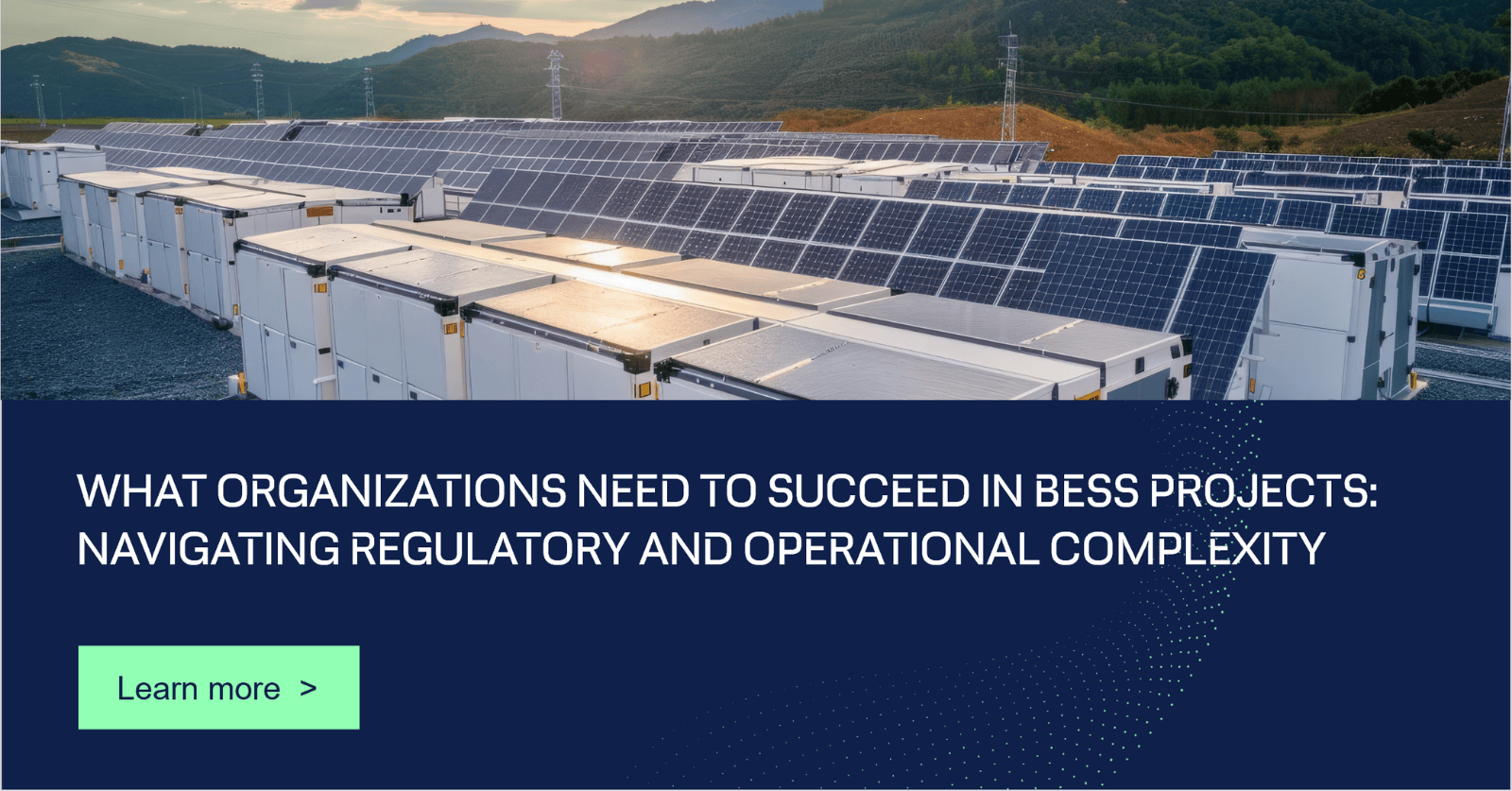
Grid-connected energy storage capacity is expected to double between 2024 and 2030, according to the DNV ETO report of 2025. Organizations entering renewable energy projects particularly in BESS (Battery Energy Storage Systems) often find themselves navigating a landscape with more complex technical and regulatory requirements than they expected. Some are challenged with expertise around systems such as Energy Management Systems and SCADA systems or the technical depth required to integrate assets to comply with local regulations, including how projects must function within a specific country’s regulatory and grid environment and market services adoption and integration.
Cybersecurity restrictions can provide a hurdle to using existing platforms in specific regions, adding another layer of uncertainty. In addition, operational challenges such as ever-changing technical requirements can create additional expectations. In this article, we will help guide you on what organizations need to succeed in BESS projects, including practical tips on choosing a partner, and technical and regulatory considerations to ensure successful project delivery.
Selecting partners for BESS projects: the essentials
“Selecting partners for BESS projects requires aligning several critical factors. It’s important to assess the partner’s track record: their history in the market, their experience operating in the specific country, and whether they have previously worked with the chosen battery OEM (Original Equipment Manufacturer) and PCS Manufacturer, amongst the other systems and stakeholders in the project. In addition, the chosen solution must offer enough flexibility and maintain strong cybersecurity standards.” Luis Serrano, Growth Segment Director BESS
Some of the essentials to look for are:
- Proven BESS and controls‑integration experience, especially with multi‑vendor SCADA/EMS environments
- Strong project‑delivery capability with disciplined commissioning and predictable timelines
- Safety and compliance expertise across standards like UL 9540/9540A, NFPA 855, and local grid codes
- Commercial alignment with no competitive conflicts and the financial strength to support long‑term obligations.
Equally important is a collaborative working style that communicates clearly and escalates issues early.
Solution flexibility and grid code compliance: considerations
“The partner needs the ability to deliver solutions that are able to adapt or quickly develop new functionalities — including updates driven by evolving grid‑code requirements. The system or systems should not be a black box; it must be transparent, fast, and reliable, especially since response‑time expectations in BESS projects are typically very demanding.” says Luis.
Regulatory and grid‑code compliance for BESS projects is about ensuring the system behaves exactly as the local grid operator requires, and the strongest partners are the ones who already know the regional rules, approval workflows, and testing expectations.
The essentials to look for are partners with deep local grid‑code knowledge (frequency response, voltage control, FRT, ramp limits), proven capability in power‑system studies (load‑flow, short‑circuit, EMT, and validated dynamic models), strong controls‑integration skills to tune system behavior to operator requirements, a track record of passing grid‑compliance tests during FAT/SAT/commissioning, and disciplined regulatory documentation that avoids delays with utilities.
Cybersecurity regulations: including the NIS2 directive
Cybersecurity adds a layer of complexity and regulations that vary across regions; that a chosen partner should be thoroughly familiar with. For example:
In the European Union:
- The NIS2 Directive, an update to the 2016 NIS rules required all member states to adopt it into national law by 17 October 2024.
- This directive is in line with other regulations such as IEC 62443, a series of international standards for the cybersecurity of Industrial Automation and Control Systems (IACS). Read our article on the topic here.
The United States follows a separate model:
- Relying on sector‑specific bodies like NERC, FERC, and the CIP standards to define cybersecurity expectations for energy providers. Take a look at our article on the topic here.
Across regions, organizations also rely on ISO 27001, the globally recognized standard for information security managements.
Advanced technical features: including POD control, black start, and grid-forming

“BESS is still rapidly growing, and the entire industry is learning as it evolves. Therefore, it’s normal for organizations to be building their understanding of how storage works and what value it can deliver. The knowledge gaps and frequent questions are simply a reflection of this.” Says Luis.
Advanced technical features such as POD control, black start capability, grid‑forming and synthetic inertia modes, and advanced fault‑ride‑through behaviour are increasingly important because they show whether a BESS partner can deliver a system that meets modern grid expectations and supports long‑term regulatory compliance. As grid codes evolve, storage assets are expected to provide stability services, damping oscillations, supporting frequency, riding through disturbances, and even helping re‑energize parts of the grid after an outage.
The industry is still maturing, and having these advanced features built in helps bridge that knowledge gap and provides confidence that a partner can deliver a technically robust, future‑proof solution even as requirements continue to evolve.
Project use case: PV & BESS hybrid solar and storage project in South America
This project is an example of a utility‑scale hybrid project (PV & BESS storage) that GreenPowerMonitor, a DNV company (GPM), partnered on to help meet national energy demand. In this project, GPM’s equipment operates as a slave system, working hand in hand with another SCADA and controller provider. The installation forms part of a broader four‑phase development exceeding 1.4 GW.
Key project capacities
- Solar PV: more than 300 MW
- Battery Energy Storage Systems: more than 100 MWh
Role and delivered solutions
GPM provided a comprehensive suite of control and monitoring technologies tailored to the project’s operational and grid‑integration needs, including:
- GPM SCADA
- GPM Power Plant Controller
- GPM Energy Management Systems
GPM’s engineering and grid‑integration teams collaborated closely with project partners to deliver a robust and flexible control architecture, ensuring reliable performance and smooth integration within the multi‑vendor environment.
To find out more about our solutions, download the brochure on our Energy Management Systems and Power Plant Controllers.
GPM: Our experience in Battery Energy Storage Systems and hybrid projects
At GPM, we are a global company with a solid track record, but what defines us just as much as our experience is the way we work with partners. We bring proven knowledge in grid‑code compliance across different countries, hands‑on experience with black start and grid-forming capabilities, and a history of delivering large, complex projects. At the same time, we aim to stay approachable and flexible. We can integrate with different solutions (supported by a library of 400+ protocols) and we bring the adaptability needed to fit into diverse system architectures and support complex project requirements.
Our solutions meet key cybersecurity standards including NIS2, IEC 62443, and ISO27001. From cybersecurity packages to POD and hybrid options, we deliver advanced and configurable capabilities for demanding projects.
To date, we have delivered BESS storage and hybrid projects in:
- Europe (Spain, Italy, UK, France, Finland, Denmark, Poland, Germany, Belgium, and the Netherlands)
- America (US, Mexico, Chile, Argentina, Colombia, Peru, Bolivia, and the Dominican Republic)
- APAC (Australia, Japan, Philippines, and Malaysia)
- IMEA (Uzbekistan, UAE, Saudi Arabia, India, South Africa, Egypt, Oman, and Mozambique)
Conclusion
A successful BESS or hybrid project ultimately depends on choosing partners and technologies that can navigate technical depth, regulatory complexity, and evolving grid expectations with confidence and transparency.
As the industry continues to mature, the most reliable partners are those who not only understand advanced functionalities like POD control, grid‑forming behaviour, and hybrid architectures, but who also work collaboratively, communicate clearly, and bring the experience needed to de‑risk delivery.
With the right expertise and alignment, BESS projects can move from challenging undertakings to strategic assets that strengthen grid stability and accelerate the energy transition.
What can GPM help you with?
- Technical: adapt to grid codes, standardize solutions, influence product developments
- Ways of working: define specs, coordinate delivery, connect execution with sales
- Capacity: understand project pipeline to adapt and ensure delivery
- Terms and conditions: framework agreements
Do you want to meet us and talk to our renewable energy experts?
For more information on GPM and how we can support your BESS projects, fill in the form to request a meeting with our renewable energy experts who will be available to answer questions, provide demonstrations, and offer insights on best practices.
